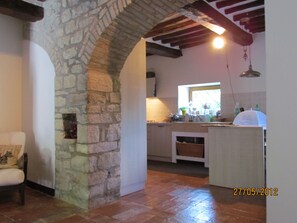
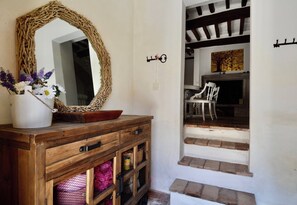
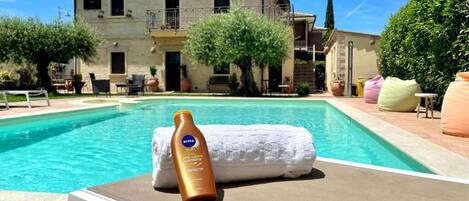
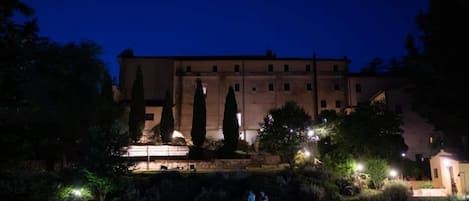
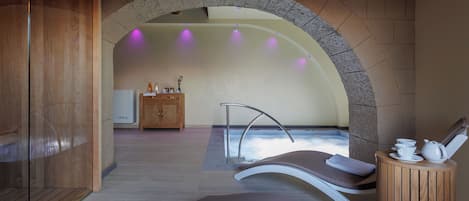
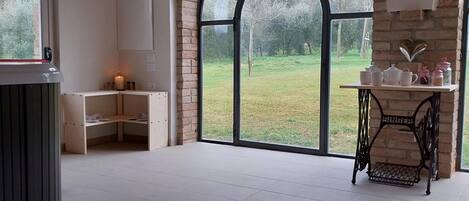
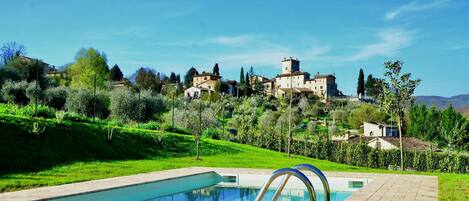
Self Catering Villa with 3 bedrooms and 3 bathrooms. Once owned by the Italian Royal family this property has been recently renovated and upgraded to modern standards.
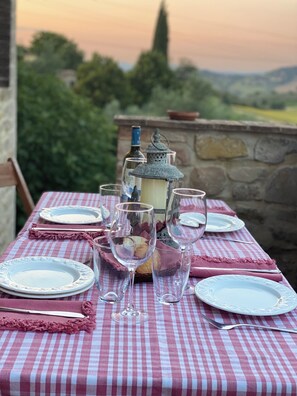
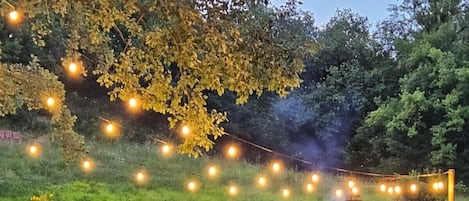
With a large garden and spectacular views this is an ideal getaway from the noise and stress of large cities.
This ancient villa has been lovingly restored to it's original charm and takes you back the fascinating origins recaptured in the careful renovation with an added touch of class and elegance resulting in a quality villa which retains all its past charms and delights.
Umbria is a region of modern central Italy. It is one of the smallest Italian regions and the only peninsular region that is landlocked. Its capital is Perugia. Assisi and Norcia are historical towns associated with St. Francis of Assisi, and St. Benedict.
Almost all Todi's main medieval monuments — the co-cathedral church (Duomo), the Palazzo del Capitano, the Palazzo del Priore and the Palazzo del Popolo — front on the main square on the lower breast of the hill: the piazza is often used as a movie set. The whole landscape is sited over some huge ancient Roman cisterns, with more than 500 pits, which remained in use until 1925.
The Cathedral
The Cathedral (11th century) is a Gothic edifice on the Lombard plan, said to be erected over an ancient Roman building, probably a temple dedicated to Apollo (here an ancient bronze statue of Mars [1], now at the Vatican Museum, was found). The current church was almost totally rebuilt after a fire in 1190. The main feature of the squarish façade is the central great rose-window, added in 1513. Of the same period is the wooden door of the portal, by Antonio Bencivenni from Mercatello, of which only the four upper panels remain today.
The church follows the plan of the Latin cross, with a nave and two aisles. Bonifacio VIII allegedly had a second aisle on one side, commonly known as 'La navatina'. The counter-façade is occupied by a giant fresco depicting the Universal Judgment by Ferraù Faenzone, called 'Il Faenzone', a work commissioned by Cardinal Angelo Cesi, in which the influence, if nowhere near the genius, of Michelangelo is easily discerned. The choir includes the Gothic altar and a magnificent wooden choir-enclosure (1521) with two floors. One important work of art is the 13th century Crucifixion of the Umbrian school.
Palazzo del Popolo
The Palazzo del Popolo ('People's Palace') is a Lombard-Gothic construction already existing in 1213, and is one of the most ancient communal palaces in Italy. It comprises two great halls: the 'Sala Grande Inferiore', or 'Sala delle Pietre', and the 'Sala Grande Superiore', housing the city's Art Gallery.
Palazzo del Capitano
The 'Captain's Palace', in Italian Gothic style, was built around 1293 and named 'New Communal Palace' to differentiate it from the former one. It is on two distinct levels: the first floor housed the Justice Hall (currently, seat of the Communal Council), with the Judges's offices in the lower. The latter is now occupied by the City Museum, with findings and remains of Todi's history. It includes a saddle used by Anita Garibaldi. Some rooms are frescoed with histories of the city and portraits of its most illustrious men.
Palazzo dei Priori
The Prior's Palace is located in the southern side of the Piazza, facing the Cathedral. It was begun in 1293 and later enlarged as seat of the podestà, priors and the Papal governors. The trapezoidal tower was originally lower, and had Guelph merlons. The façade includes a big bronze eagle by Giovanni di Giliaccio (1347).
Palazzo Vescovile
Located at the left of the Cathedral, the Bishop's Palace was built in 1593 by Cardinal Angelo Cesi at his own expense. His crest is visible over the great portal, attributed to Vignola. The upper floors include a room frescoed by Ferraù Fenzoni and a gallery frescoed by Andrea Polinori in 1629.
The unfinished façade of San Fortunato.
Santa Maria della Consolazione, early 16th century: the central Greek-cross plan with apsidal transepts recalls Bramante's first plans for St Peter's.
Other sights
The church of San Fortunato and the sparse ruins of a medieval fortress (Rocca) lie on the other crest of the hill on which the city is built. San Fortunato is a Palaeo-Christian temple (7th century) of which two lion sculptures on the entrance portal remain. In 1292 the construction of a new Gothic edifice was begun by the Franciscans, with a 'hall' structure. Works, however, were halted during the plague of 1348. The lower part of the façade was finished in the second half of the 15th century. The nave and the two aisles have a portal each: these are enriched by fine decorations portraying saints and prophets, with briar representing Good (the vine) and Evil (the fig). The whole apse is occupied by a wooden choir finished in 1590 by Antonio Maffei, from Gubbio. The crypt houses a sepulchre containing the remains of St. Fortunatus of Todi and other saints, as well as the tomb of Jacopone da Todi. Another noteworthy artpiece is a Madonna and Child by Masolino da Panicale.
The domed Renaissance church of Santa Maria della Consolazione (begun in 1508), located on the flank of the city hill, just outside the walls, is often attributed, although without sufficient reason, to Bramante. It has a Greek cross plan: three apses are polygonal and that on the north side is semicircular. Architects who worked on it include Cola da Caprarola, Antonio da Sangallo the Younger, Baldassarre Peruzzi, Galeazzo Alessi, Michele Sanmicheli, Vignola and Ippolito Scalza. The church was inaugurated only in 1607. The apse is surmounted by a square terrace with 4 eagles at the corners, from which the dome rises. In the interior, the altar houses a miraculous image of the Madonna, which, according to the tradition, was discovered by a worker during the founding works. 12 niches in the first three apses house giant statues of the apostles. Also noteworthy is the wooden statue of Pope Martin I, a native of the Todi area.
Todi is surrounded by three more or less complete concentric walls: the outermost is medieval, the middle wall is Roman, and the innermost is recognizable as partly Etruscan. Sights include also a colossal Roman niched substructure of uncertain purpose (the Nicchioni), the slight ruins of a Roman amphitheatre, about a dozen smaller churches, and a few Renaissance or classical palazzi, among which the most important is one by Vignola, round out the sights. The neighbourhood of the city has many historical castles, fortresses and ancient churches including the famous Todi Castle in Umbria which was once used for the purpose of war has now been restored by the Santoro family and is used as a vacation spot for visitors.