Centro de la ciudad de Solo

Surakarta

At the museum no photos are allowed which is really unfortunate as it was well worth the visit and the guided tour is definitely not to be missed. In the museum there are even Batik made from the Dutch era which depicts stories like Little Red Riding Hood and Snow White!

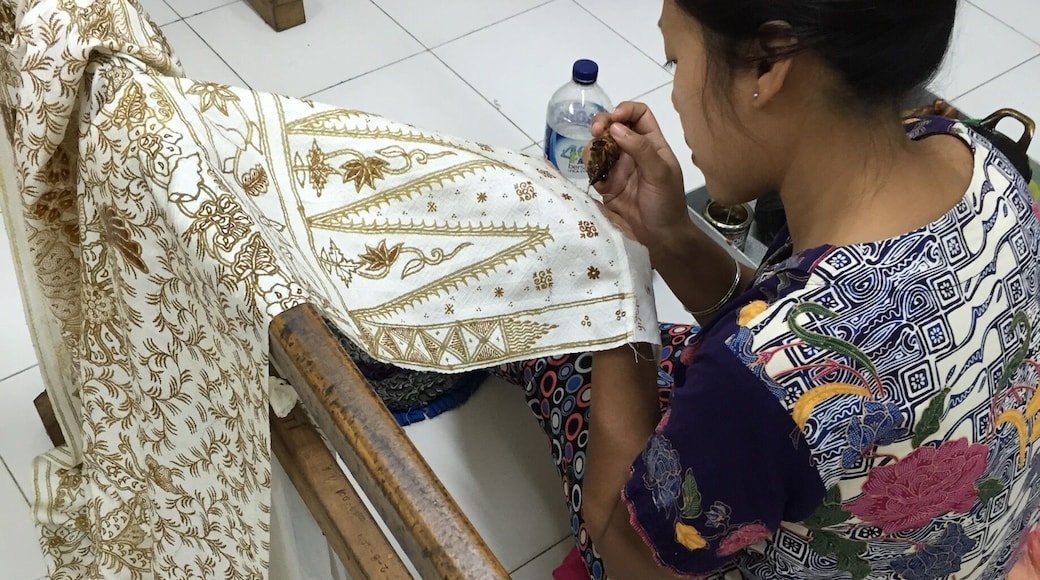
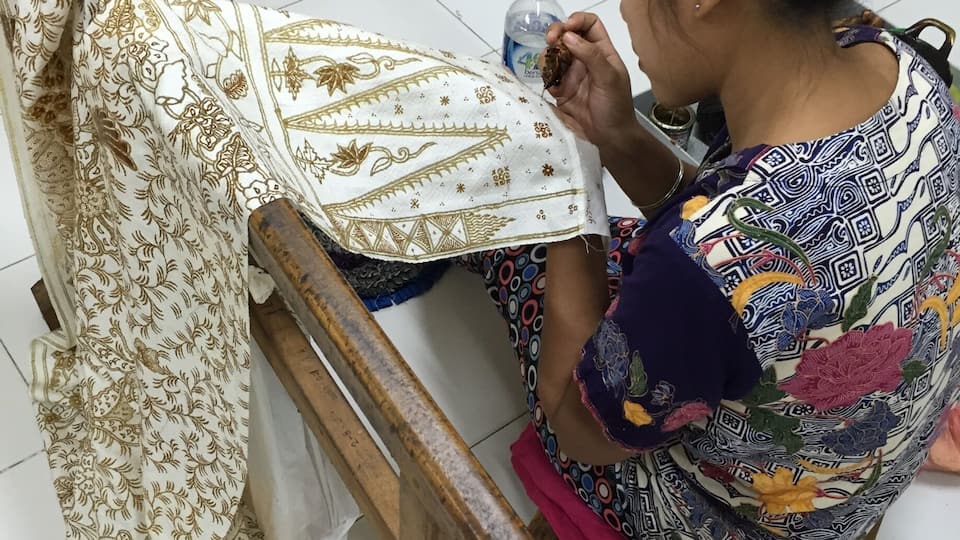
I enjoyed the tour v much and at the end of the tour we were brought to this room where the artisan were working on hand drawn batik.

Below is an excerpt from Wikipedia for anyone interested in learning more about the process of batik making.

Firstly, a cloth is washed, soaked and beaten with a large mallet. Patterns are drawn with pencil and later redrawn using hot wax, usually made from a mixture of paraffin or bees wax, sometimes mixed with plant resins, which functions as a dye-resist. The wax can be applied with a variety of tools. A pen-like instrument called a canting (IPA: [tʃantiŋ], sometimes spelled with old Dutch orthography tjanting) is the most common. A canting is made from a small copper reservoir with a spout on a wooden handle. The reservoir holds the resist which flows through the spout, creating dots and lines as it moves. For larger patterns, a stiff brush may be used. Alternatively, a copper block stamp called a cap (IPA: [tʃap]; old spelling tjap) is used to cover large areas more efficiently.

After the cloth is dry, the resist is removed by scraping or boiling the cloth. The areas treated with resist keep their original color; when the resist is removed the contrast between the dyed and undyed areas forms the pattern. This process is repeated as many times as the number of colors desired.

The most traditional type of batik, called batik tulis (written batik), is drawn using only the canting. The cloth need to be drawn on both sides and dipped in a dye bath three to four times. The whole process may take up to a year; it yields considerably finer patterns than stamped batik.

Source: Wikipedia
At the museum no photos are allowed which is really unfortunate as it was well worth the visit and the guided tour is definitely not to be missed. In the museum there are even Batik made from the Dutch era which depicts stories like Little Red Riding Hood and Snow White!

I enjoyed the tour v much and at the end of the tour we were brought to this room where the artisan were working on hand drawn batik.

Below is an excerpt from Wikipedia for anyone interested in learning more about the process of batik making.

Firstly, a cloth is washed, soaked and beaten with a large mallet. Patterns are drawn with pencil and later redrawn using hot wax, usually made from a mixture of paraffin or bees wax, sometimes mixed with plant resins, which functions as a dye-resist. The wax can be applied with a variety of tools. A pen-like instrument called a canting (IPA: [tʃantiŋ], sometimes spelled with old Dutch orthography tjanting) is the most common. A canting is made from a small copper reservoir with a spout on a wooden handle. The reservoir holds the resist which flows through the spout, creating dots and lines as it moves. For larger patterns, a stiff brush may be used. Alternatively, a copper block stamp called a cap (IPA: [tʃap]; old spelling tjap) is used to cover large areas more efficiently.

After the cloth is dry, the resist is removed by scraping or boiling the cloth. The areas treated with resist keep their original color; when the resist is removed the contrast between the dyed and undyed areas forms the pattern. This process is repeated as many times as the number of colors desired.

The most traditional type of batik, called batik tulis (written batik), is drawn using only the canting. The cloth need to be drawn on both sides and dipped in a dye bath three to four times. The whole process may take up to a year; it yields considerably finer patterns than stamped batik.

Source: Wikipedia

Lugares más visitados

Actividades


Principales hoteles en Centro de la ciudad de Solo

Novotel Solo

Novotel Solo

4 out of 5
Jalan Slamet Riyadi 272 Surakarta Central Java
Del 27 feb al 28 feb, el precio por noche es de AR$ 38.721
AR$ 38.721
AR$ 46.853 en total
27 feb. - 28 feb.
impuestos y cargos incluidos
Hospédate en este hotel con spa en Surakarta. Aprovecha el acceso a wifi gratis, el estacionamiento gratis y 2 piscinas al aire libre. Estarás muy cerca de atracciones ...
8/10 Very Good! (113 opiniones)
房間乾淨,服務也很到位,有提供飲用水,但是浴室有很多發霉的地方,抽風機會發出巨大的噪音,可能要更換比較好

Enviada el 4 sept. 2025

Novotel Solo
The Royal Surakarta Heritage - Handwritten Collection

The Royal Surakarta Heritage - Handwritten Collection

5 out of 5
Jalan Slamet Riyadi No. 06 Surakarta Central Java
Del 17 feb al 18 feb, el precio por noche es de AR$ 40.378
AR$ 40.378
AR$ 48.857 en total
17 feb. - 18 feb.
impuestos y cargos incluidos
Hospédate en este hotel de lujo en Surakarta. Aprovecha el acceso a wifi gratis, el estacionamiento gratis y el spa de servicio completo. Estarás muy cerca de ...
8,2/10 Very Good! (166 opiniones)
Para repetir...
Excelente relación calidad-precio. El hall es impresionante pero las habitaciones ya empiezan a pedir una reforma... Aún así, totalmente recomendable. ( muy bien situado)

Enviada el 26 jul. 2017

The Royal Surakarta Heritage - Handwritten Collection
ibis Styles Solo

ibis Styles Solo

3 out of 5
Jalan Gajah Mada 23 Surakarta Central Java
Del 27 feb al 28 feb, el precio por noche es de AR$ 30.507
AR$ 30.507
AR$ 36.914 en total
27 feb. - 28 feb.
impuestos y cargos incluidos
Hospédate en este hotel con spa en Surakarta. Aprovecha el acceso a wifi gratis, el estacionamiento gratis y 2 piscinas al aire libre. Estarás muy cerca de atracciones ...
8/10 Very Good! (103 opiniones)
Aceptable calidad precio
No limpian los cristales exteriores de la habitación hace años están amarillos de suciedad

Enviada el 17 may. 2012

ibis Styles Solo
FIM by Zigna

FIM by Zigna

3 out of 5
31 Jl. Yosodipuro Surakarta Jawa Tengah
Hospédate en este hotel con spa en Surakarta. Aprovecha el acceso a wifi gratis, el estacionamiento gratis y el spa de servicio completo. Estarás muy cerca de ...
9,4/10 Exceptional! (6 opiniones)
The hotel is an excellent place to stay. The hotel itself is not special or fancy, but it is well-run, clean, and located in the center of Solo. The breakfast buffet is excellent, the restaurant is good, and the hotel also has a nice cafe with an outside seating area. They featured life music at ...

Enviada el 19 jul. 2025

FIM by Zigna
Comfort Centre Residence Solo

Comfort Centre Residence Solo

2 out of 5
Jalan RM. Said Surakarta Jawa Tengah
Del 4 mar al 5 mar, el precio por noche es de AR$ 22.441
AR$ 22.441
AR$ 27.153 en total
4 mar. - 5 mar.
impuestos y cargos incluidos
Hospédate en este hotel en Surakarta. Aprovecha el acceso a wifi gratis, el estacionamiento gratis y la recepción disponible las 24 horas. Estarás muy cerca ...
Comfort Centre Residence Solo
Hotel Asia

Hotel Asia

3.5 out of 5
Jl. Monginsidi No.1, Jebres Surakarta Central Java
Del 13 feb al 14 feb, el precio por noche es de AR$ 31.246
AR$ 31.246
AR$ 37.808 en total
13 feb. - 14 feb.
impuestos y cargos incluidos
Hospédate en este hotel con spa en Surakarta. Aprovecha el acceso a wifi gratis, el estacionamiento gratis y el spa de servicio completo. Estarás muy cerca de ...
Properti kurang terawat

Enviada el 29 ago. 2022

Hotel Asia
Precio por noche más bajo encontrado en las últimas 24 horas para una estadía de una noche para dos adultos. Los precios y la disponibilidad están sujetos a cambios. Es posible que se apliquen más términos.

Otros barrios como Centro de la ciudad de Solo

At the museum no photos are allowed which is really unfortunate as it was well worth the visit and the guided tour is definitely not to be missed. In the museum there are even Batik made from the Dutch era which depicts stories like Little Red Riding Hood and Snow White!

I enjoyed the tour v much and at the end of the tour we were brought to this room where the artisan were working on hand drawn batik.

Below is an excerpt from Wikipedia for anyone interested in learning more about the process of batik making.

Firstly, a cloth is washed, soaked and beaten with a large mallet. Patterns are drawn with pencil and later redrawn using hot wax, usually made from a mixture of paraffin or bees wax, sometimes mixed with plant resins, which functions as a dye-resist. The wax can be applied with a variety of tools. A pen-like instrument called a canting (IPA: [tʃantiŋ], sometimes spelled with old Dutch orthography tjanting) is the most common. A canting is made from a small copper reservoir with a spout on a wooden handle. The reservoir holds the resist which flows through the spout, creating dots and lines as it moves. For larger patterns, a stiff brush may be used. Alternatively, a copper block stamp called a cap (IPA: [tʃap]; old spelling tjap) is used to cover large areas more efficiently.

After the cloth is dry, the resist is removed by scraping or boiling the cloth. The areas treated with resist keep their original color; when the resist is removed the contrast between the dyed and undyed areas forms the pattern. This process is repeated as many times as the number of colors desired.

The most traditional type of batik, called batik tulis

Banjarsari

Si estás en Banjarsari, puedes ir a lugares como Solo Paragon Lifestyle Mall (centro comercial) y Parque de la ciudad Balekambang.

Banjarsari


Centro de la ciudad de Solo

Selecciona uno o más elementos para ahorrar: